
I discovered him in 2005, in a quiet corner of a small bookstore in Portland, Oregon. A slim volume with an unsettling title caught my attention. I had never heard of the author before: Emmanuel Todd, a French demographer, historian, and ethnographer.
The book was After the Empire: The Breakdown of the American Order. I sometimes wonder whether it unsettled me as much as it did because I had only recently immigrated to the United States.
But as I picked up the volume, my unease turned to inquisitiveness. I learned from the back cover that he had foretold the collapse of the Soviet system 15 long years in advance.
Struck by his record of prescience, I bought it on the spot and spent the next few days unpacking the rather gloomy message. The argument was quite convincing. But the few people I shared it with were mildly derisive at best. It took roughly 15 years before I began to sense a shift in the broader sentiment.
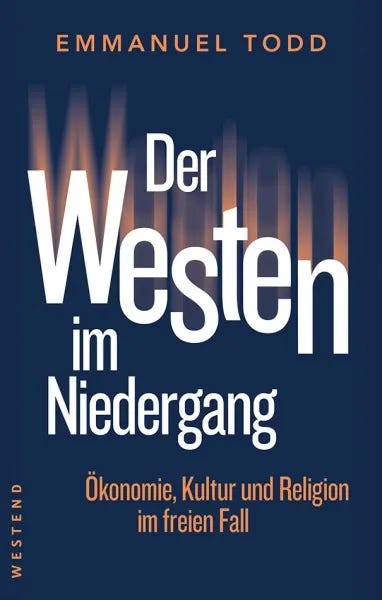
The same author has now published a third similar book titled La Défaite de l’Occident (loosely translated: The Defeat of the West). I had to find out what grim news he has this time. But I don’t speak French, and there is no English translation. Fortunately, the German version came out recently. I got a copy of Der Westen im Untergang and read it with interest.
This time too, I found the book convincing - perhaps also because of my own observations. Here again, Emmanuel Todd uses a host of demographic trends - things like fertility rates, life expectancy, suicide patterns, marriage rate, literacy and education pattern, etc. – to make his case.
But I am not going to dwell on these metrics and trends. That would make for rather dry reading. Nor will I try to convince you that Todd’s conclusions are correct. Unless asked, I tend to leave others’ opinion be their own business.
Instead, I want to focus on why Todd thinks these changes are happening. That, to me, is far more thought provoking – even if open to debate.
A brief aside: I used to read nonfiction mainly to learn new facts and assumptions. That’s still true to a degree. But over time, I’ve come to value something else even more. It’s the ways in which other thinkers connect facts and assumptions.
I find this interesting because conclusions are, in essence, opinions. We arrive at them by logically linking together what we take to be facts and assumptions – or “dots” as I like to call them. (I explored this idea in an earlier post, An Opinion About Opinions.)
Coming back, then, to Todd’s book, I found two of his whys for the decline of the West especially intriguing. As you’ll see later, they offer an interesting way of connecting “dots”.
Dramatic changes rarely happen for a single reason, and what one sees as a why often depends on one’s perspective. For the decline of the West, one of Todd’s more surprising explanations is religion. It is surprising because he himself has a secular outlook and is not a religious thinker.
The other why is nihilism. This is also unexpected, because Todd is not a philosopher.
Religion
My aha moment came in the section on religion. I was already aware that religion has always been deeply interwoven with human history. But I had not thought deeply about the cause and effect relationship Emmanuel Todd presents here.
Todd, however, approaches religion not as a theologian or moral thinker, but as a demographer. He views religion as a force that shapes culture and institutions. These changes ultimately influence the course of history.
He starts off by providing an example from the past. There was a clear asymmetry in the rise of the West.
Regions that were predominantly Protestant (England, Netherlands, Germany, and Scandinavia) became early centers of education, industrialization, and political modernization. Regions that were largely Catholic (Southern Europe, and parts of France), followed later.
Todd explains this difference through certain features of Protestantism. For example, its emphasis on individual Bible reading encouraged mass literacy. It is easy to forget how revolutionary universal literacy once was, and what it can do to a society.
A focus on a personal relationship with God in Protestantism encouraged individual responsibility. And its relatively weaker hierarchical structure was more compatible, in his view, with democracy and capitalism.
Also in the United States, one might loosely connect the country’s early development to the historical influence of the WASP (White Anglo Saxon Protestant) culture.
At this point in the book, I started wondering how societies and, perhaps history itself, would change if the influence of religion declines. That’s exactly what Todd does next – explaining the changes that unfold in a sequential manner.
When religion is strong and active, both belief and practice are deeply rooted in everyday life. They play a strong role in shaping family structures, moral expectations, and social norms.
But as religion weakens, many values - like discipline, literacy, family norms, etc. – still persist but more in a cultural sense. Formal opposition to practices such as divorce, abortion, non-traditional family structures, etc. remains, but their practical acceptance grows. For many, the connection to religion becomes limited to life events like birth, marriage, and death. Religion now becomes more of a cultural phenomenon.
Soon, religion is no longer meaningfully believed in, and its practices thin out. The remaining fragments of social habits and intuitions that remain often do so in unstable or contradictory ways. The society reaches a “zombie” religious phase.
In Todd’s account, societies may eventually move toward a post-religious phase. As the role of belief and religion disappear, shared common norms and values erode – both at individual and societal level. Something starts to emerge that Todd calls “nihilism”.
Nihilism
Emmanuel Todd’s use of the term “nihilism” is somewhat unusual. He doesn’t use it in the traditional philosophical sense – such as the loss of meaning, truth or value – nor in the looser cultural sense of disillusionment or skepticism.
Instead, he uses it more as a diagnosis of societal breakdown. His question is not what happens when meaning collapses, but what a society looks like once the collapse is already underway. I find this shift in perspective particularly striking and interesting.
Therefore, when he gives examples of “nihilistic” patterns of behavior in a “post-religious” society, he does so less by establishing clear cause and effect relationships than by drawing connections across a range of observations.
Some of these relate to individual or societal behavior (rising suicide rates among young males, declining fertility, household structures). Others extend to political/economic decisions that are self-undermining. He specifically points out European Union’s sanction policy towards Russia. Other examples include increasing polarization in politics and a sense that the government is more focused on managing a decline rather than creating true alternative solutions.
Emmanuel Todd explains the West’s decline in a way by placing religion near the center of the story. Others have tried to explain the decline in other ways.
Thomas Piketty, for example, assumes that economic inequality and capital concentration play a central role. But for Francis Fukuyama institutional decay and political dysfunction play a central role. Still others view civilizational decline as part of a broader life cycle (Oswald Spengler).
Who is right? That would be the wrong question. Complex processes defy one single explanation. The decline of the West is no different. It’s a tangled web of many strands that push and pull in many directions. Therefore, I don’t believe that just one factor decides the outcome.
Instead, the question I ask is whether Todd has illuminated a corner of the tangled web that I hadn’t quite seen before or shed light on a strand I wasn’t aware of before. The answer, at least for me, is yes, and yes, on both counts.
It was a great read. But like many great reads, it answered some questions while raising other, even bigger, ones. One of them has stayed with me in particular: why do human societies need religion at all?
But that is a much larger trail, perhaps one without a clear trail guide. Who knows, I might wander down it one day.
New to this publication? Read here what it is all about: WELCOME to Outsights of a Conspecific
You might also enjoy how my life changed When My Grandfather Challenged the Truth
I write solely for the pleasure of writing. That pleasure is even greater when others enjoy reading.
If this piece resonated with you, feel free to subscribe (it’s free). I publish about once every three weeks, and you’ll get an email when something new is out.
And if you know someone else who might enjoy this kind of writing, please consider sharing it with them too.